Hardcore drugs, tobacco and alcohol are chief substances consisting of underlying toxic ingredients, that may lead to irreversible health damage or untimely demise of an individual. And the bitter ground reality is that more than half of the substance abusers are youths. And more often than not, they start very young.
Children may learn what they perceive from their environment, be it under the boundary of their home and surveillance, the premises of the educational institution and supervision or simply around peer groups outside in the recreational zones. We can never be too careful when it comes to unanticipated addiction to lethal substances. Young minds tend to be naive hence, they get deeper into such habits, even when they want to get out of the addiction. And it is inevitable that once an individual falls into the trap of addiction, it is relatively harsh to come back to sobriety and fit into the norms of society.
Extreme addiction to illicit substances also has a higher likelihood in carving the path to criminal and unlawful directions. Instances of addiction and withdrawal have led to sinful crimes such as murder, smuggling, robbery and kidnapping amongst others. However, the consequences of substance addiction aren't limited to criminal activities alone. It can drastically affect one’s mental and physical health to the point of no return; in extreme cases, it may also lead to death.
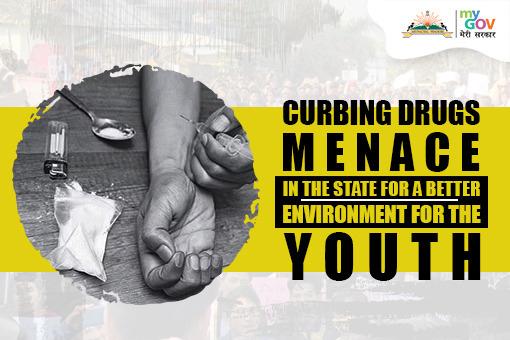
Keeping the unfavourable aspects of toxic substance consumption as context, MyGov Arunachal invites you to share your valuable suggestions on measures to tackle drug menace-related issues in the state.









Farvez Basha D 3 years 2 months ago
Between 1998 and 2004, the US Congress appropriated nearly $ 1 billion for the National Youth Anti-Drug Media Campaign.
Farvez Basha D 3 years 2 months ago
Through June 2004, the campaign is unlikely to have had favorable effects on youths and may have had delayed unfavorable effects. The evaluation challenges the usefulness of the campaign.
Farvez Basha D 3 years 2 months ago
Exposure at round 3 predicted marijuana initiation at round 4 (γ = 0.11; 95% CI = 0.00, 0.22).
Farvez Basha D 3 years 2 months ago
Most analyses showed no effects from the campaign. At one round, however, more ad exposure predicted less intention to avoid marijuana use (γ = −0.07; 95% confidence interval [CI] = −0.13, −0.01) and weaker antidrug social norms (γ = −0.05; 95% CI = −0.08, −0.02) at the subsequent round.
Farvez Basha D 3 years 2 months ago
Main outcomes were self-reported lifetime, past-year, and past-30-day marijuana use and related cognitions.
Farvez Basha D 3 years 2 months ago
From September 1999 to June 2004, 3 nationally representative cohorts of US youths aged 9 to 18 years were surveyed at home 4 times. Sample size ranged from 8117 in the first to 5126 in the fourth round (65% first-round response rate, with 86%–93% of still eligible youths interviewed subsequently).
Farvez Basha D 3 years 2 months ago
We examined the cognitive and behavioral effects of the National Youth Anti-Drug Media Campaign on youths aged 12.5 to 18 years and report core evaluation results.
Farvez Basha D 3 years 2 months ago
We examined the cognitive and behavioral effects of the National Youth Anti-Drug Media Campaign on youths aged 12.5 to 18 years and report core evaluation results.
Santanu Datta 3 years 2 months ago
Strong vigilance and rehabilitation is necessary to curve this menace of the society.
Santanu Datta 3 years 2 months ago
Strong vigilance and rehabilitation is necessary to curve this menace of the society.