Road maintenance and Traffic management as a responsibility.
Road connectivity makes a crucial contribution to the growth of the state and its economic and social development. Almost every passenger, commercial and industrial transports are carried out through roads in Arunachal Pradesh. The increase in the private vehicle ownership and urban transports has led to overburdening of roads not only in Itanagar and Naharlagun but all major cities of the country. This exaggeration of road promptly reduce the quality of roads, and most of the expenditure is spent on the maintenance of roads every year rather than expansion of the roads. The variations in weather and climate also make it extremely difficult to control the quality of roads in the state.
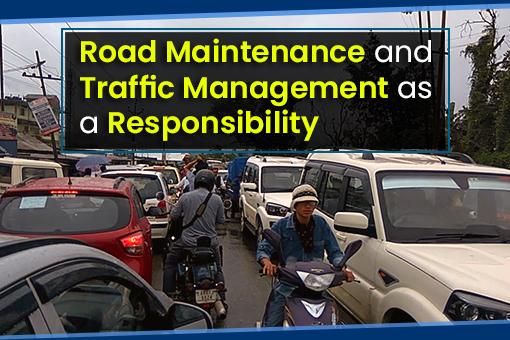
The roads in urban towns are exceedingly congested due to heavy traffic caused by private, commercial and government vehicles. Traffic issues in the state capital and Naharlagun town areas have turned into a huge menace for the commuters. It has turned into a harsh cliché where bad roads create traffic issues, and the traffic ceases any scope for the development of new roads. The daily struggle and effort of dodging traffic, pollution and rash drivers may cause chronic stress and many physiological problems. Traffic not only creates congestion issues, but it also gives rise to air pollution and sound pollution.
The capital administration and the citizens will have to work in tandem if the state wants to fight the traffic menace in the state capital and see any improvement in traffic and eventually in the lives of the citizens. But this might not be possible if the commuters continue to abuse the roads and break traffic rules. Maintaining traffic rule is a responsibility that should be followed by everyone including individual, commercial, private and government commuters.
MyGov Arunachal Pradesh seeks suggestions from the citizens on how the quality of the roads can be maintained and traffic issues can be managed by the administrations.









Bhawna 6 years 5 months ago
and right of way and abutting development regulation, to varying degrees. The responsibility for the setting of speed limits on all roads, or perhaps just for national or state roads, while issuing guidance for speed limits and design standards on local roads is likely to rest with national or state road authorities. However, this is less likely to be the situation in a number of LMICs.
Bhawna 6 years 5 months ago
RESPONSIBILITIES WILL REFLECT APPLICABLE LEGISLATION
Relevant legislation and regulations will prescribe the functions and responsibilities of a road authority in a country. While the nature and extent of these responsibilities varies from country to country, it will usually encompass planning and construction for major new road projects, safety, asset management, traffic management, road maintenance,
Bhawna 6 years 5 months ago
Qualifications and Training
There are no formal qualifications required for becoming a traffic safety and control officer; however, you may want to complete GCSEs in Maths and English or their equivalents, such as the Welsh Baccalaureate or Scottish Nationals.
For a more senior role, training in first aid, traffic management or health and safety can be an advantage.
Bhawna 6 years 5 months ago
Undertaking continuous improvement by monitoring user experience and making changes accordingly
Planning the safest, quickest and most efficient routes
Typically, Traffic Safety and Control Officers work a 24/7 shift pattern, switching between night, early and late shifts, and rest days.
Work can be anywhere throughout the UK, or even internationally on a large project, meaning travel and overnight stays are common
Bhawna 6 years 5 months ago
The Role
Traffic Safety and Control Officers make important decisions on how best to design the layout and management of traffic
Providing a highly visible presence at road traffic incidents
Predicting potential issues on a planned route
Managing handling of incidents, such as road traffic collisions, and arranging the swift removal of debris and other risks
Keeping traffic flow as smooth as possible without compromising safety
Creating accurate reports
Hindusree Tallapally 6 years 5 months ago
Traffic issues is due to population size,new vehicle lunch became more tougher to handle.It is to be suggested more traffic posts, wide roads at least four ways and pedestrians path ,more traffic police require and a highway controling setup are cardinal.Traffic issue is a long awaited desire of India though the road , railway etc linkage became wide.Traffic police should be with a motorcycle and patrol the situation and solutions immediately check out.
Mandar Das 6 years 5 months ago
From all the comments received so far, it is eminent that indeed road conditions in the state have deterioratedis and is not safe for commuters. State Government must come up with a remediation plan to bring some relief to the people by giving them proper roads to commute.
Sijna Jose 6 years 5 months ago
Road traffic control involves directing vehicular and pedestrian traffic around a construction zone, accident or other road disruption, thus ensuring the safety of emergency response teams, construction workers and the general public. While the nature and extent of these responsibilities varies from country to country, it will usually encompass planning and construction for major new road projects,safety,asset management,traffic management,road maintenance. safety inspection of the road.
Susanta Kumar Pattnaik 6 years 6 months ago
Traffic issues is due to population size,new vehicle lunch became more tougher to handle.It is to be suggested more traffic posts, wide roads at least four ways and pedestrians path ,more traffic police require and a highway controling setup are cardinal.Traffic issue is a long awaited desire of India though the road , railway etc linkage became wide.Traffic police should be with a motorcycle and patrol the situation and solutions immediately check out.
Vikash Kumar Pandey 6 years 6 months ago
Road maintenance involves remedying defects such as potholes that occur in the carriageway from time to time (corrective maintenance) and providing treatments such as crack sealing which will slow the rate of deterioration (preventative maintenance).
Routine Maintenance means maintenance activities that are scheduled in advance and occur on a regular basis, such as weekly, monthly, quarterly, semi-annually or annually, which are normally included as an annually recurring cost in maintenance.