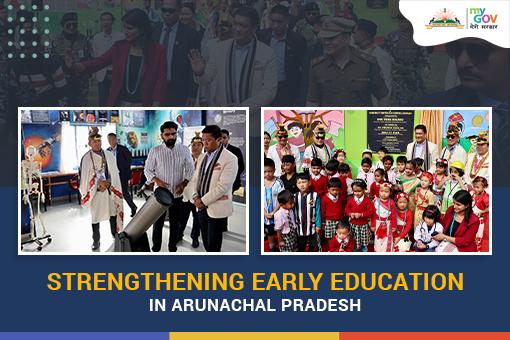
In a significant step towards strengthening early education, Hon’ble Chief Minister Pema Khandu recently inaugurated the Foundational Literacy and Numeracy (FLN) Centre at Doimukh. This initiative aligns with the vision of the National Education Policy 2020 and the NIPUN Bharat Mission, which aim to ensure that every child acquires essential reading, writing, and numeracy skills at an early stage.
The centre, initiated by the Deputy Commissioner of Papum Pare, focuses on students up to Grade 3 and seeks to build a strong learning foundation through simple, engaging, and activity-based methods. By integrating hands-on learning, basic STEM exposure, and lessons rooted in local culture and everyday experiences, the initiative makes learning more relatable and effective for young minds.
This effort highlights the importance of early intervention in education, ensuring that children not only attend school but also learn meaningfully.
Join the Discussion on MyGov Arunachal Pradesh -
We invite your valuable suggestions on strengthening foundational education:
1. What role should local languages and indigenous knowledge play in improving literacy and numeracy at the primary level?
2. How can teachers be better trained and supported to implement activity-based and STEM-oriented learning in early grades?
3. In what ways can parents and communities contribute to strengthening foundational education for children?





BrahmDevYadav 4 months 2 weeks ago
Teachers can be better trained and supported to implement activity-based and STEM-oriented learning in early grades (PreK-2) through targeted professional development, hands-on workshops, mentoring and access to practical, low-cost resources. Key strategies include focusing on pedagogy over content, fostering a "maker" culture that embraces failure and integrating STEM into daily routines rather than treating it as a separate subject.
BrahmDevYadav 4 months 2 weeks ago
What are the measures taken by the Government to improve the literacy condition in India?
The Indian government has implemented key initiatives to improve literacy, notably the Sarva Shiksha Abhiyan for universal elementary education and the Right to Education Act, guaranteeing free,compulsory education for ages 6–14. Key measures include the Mid-Day Meal Scheme to boost enrollment, the National Literacy Mission for adult education and Padhe Bharat Badhe Bharat for foundational skills.
BrahmDevYadav 4 months 2 weeks ago
How to improve the literacy skills of students?
1. Tap Into What Kids Know.
2. Make Phonics a Game, Not a Grind.
3. Active Bodies Fuel Early Literacy.
4. Reading Aloud to Build Fluency.
5. Ditch Leveled Groups and Focus on Skills.
BrahmDevYadav 4 months 2 weeks ago
What are the six basic strategies for developing literacy?
This document outlines six basic strategies for developing literacy:- making connections, visualizing, inferring, questioning, determining importance and synthesizing.
BrahmDevYadav 4 months 2 weeks ago
What are the seven Indigenous teachings?
1. Humility
2. Bravery
3. Honesty
4. Wisdom
5. Truth
6. Respect.
7. Love.
BrahmDevYadav 4 months 2 weeks ago
What are the four types of intellectual development?
1. Sensorimotor. Birth through 2 years old.
2. Preoperational. Toddlerhood through early childhood (2-7 years old)
3. Concrete operational. Ages 7-11 years old.
4. Formal operational. Adolescence through adulthood, 12 years and older.
BrahmDevYadav 4 months 2 weeks ago
What are the five important parts of intellectual development?
Once a child can move around, their intellectual development will accelerate as they are provided with new experiences to learn from. Intellectual development includes memory, concentration, reasoning, perception, imagination and creativity and problem solving.
BrahmDevYadav 4 months 2 weeks ago
What are the eight important factors that may affect the learning process?
1. Motivation. Motivation drives learning.
2. Cognitive Abilities. These include memory, attention, problem-solving and critical thinking.
3. Emotional State.
4. Environment.
5. Learning Style.
6. Prior Knowledge and Experiences.
7. Physical Health.
8. Social and Cultural Influences.
BrahmDevYadav 4 months 2 weeks ago
What are the five indigenous knowledge?
Indigenous Knowledge is living, holistic, relational, spiritual, temporal and spatial are drawn from evidence and observations; promotes sustainability; and has been passed down both orally and in written form.
BrahmDevYadav 4 months 2 weeks ago
How to promote Indigenous languages in the classroom?
Play traditional games and make traditional crafts to hear and use the Indigenous words associated with these activities. Model language use through storytelling and recounting legends. Organize activities that allow children to explore nature and to use Indigenous words to describe the things they observe.