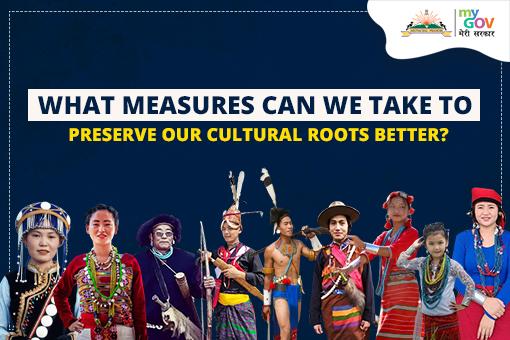
It is an indisputable fact that our culture narrates our story, and our heritage sites chronicle our history. Although the history of our indigenous culture is often scarce in written records, it has been lovingly passed down through generations via oral traditions, including folklore and poetry. Additionally, we can draw insights from the histories of more developed civilizations in the past.
In the present day, our responsibility lies in the preservation and safeguarding of the knowledge and treasures we have already unearthed and what we currently understand. Our ancestors exemplified self-reliance, leading simple yet healthy lives while cherishing and respecting the natural world.
Some of the ways to hold on to our cultural roots, are through the simple process of reviving age-old customs, including our traditional culinary practices, native dialects, art & craft, sustainable agriculture and so on. We must also embrace rituals that pay homage to nature and the spirits, including the roles of our local priests and their divine connections.
In our modernised and busy lives, it is crucial that we reconnect with our roots by visiting our villages and learning from the wisdom of our parents and elders. They represent the last generation to experience life before modernization and may be the last witnesses of a bygone era. Engaging in dialogue with our parents and elders allows us to uncover the authentic life stories of village existence, the wisdom of our grandparents, and the customs that define us, ensuring this knowledge isn't lost as they hold the last threads of our past.
Similarly, maintaining and preserving our historical sites is of utmost importance. By doing so, we can confidently narrate our cultural story to those beyond the borders of Arunachal Pradesh.
State treasures like Ita Fort, Malinithan, Parshuram Kund, etc. possess both historical and mythological significance. These sites hold the secrets of centuries past and are an integral part of our heritage, and it's our duty to protect this legacy with pride.
It would be deeply regrettable if we were unable to converse in our native dialect or lacked basic knowledge of our state and its cultural heritage when questioned. In the face of such an inquiry, our silence would be a poignant testament to our neglect. To avoid such embarrassment, we must commit to learning, preserving, protecting, and sharing the invaluable legacy of our history, culture, and traditions. It is our duty and privilege to do so with pride and dedication.
Inviting citizens of Arunachal Pradesh to share their views on how we can preserve our cultural identity better while going hand in hand with changing times.






BrahmDevYadav 2 years 10 months ago
What are the four cultural identities?
Race, gender, sexuality and ability are socially constructed cultural identities that developed over time in relation to historical, social and political contexts. Race, gender, sexuality and ability are cultural identities that affect our communication and our relationships.
BrahmDevYadav 2 years 10 months ago
How do we develop cultural awareness?
1.Think beyond race and ethnicity. A person's culture is shaped by more than the colour of
their skin or the way that they dress.
2.Learn by asking.
3.Make local connections.
4.Pay attention to non-verbal behaviours.
5.Exchange stories.
BrahmDevYadav 2 years 10 months ago
What is most important in culture?
The major elements of culture are symbols, language, norms, values and artifacts. Language makes effective social interaction possible and influences how people conceive of concepts and objects.
BrahmDevYadav 2 years 10 months ago
What does culture of a state include?
Thus, culture includes language, ideas, beliefs, customs, codes, institutions, tools, techniques, works of art, rituals and ceremonies, among other elements.
BrahmDevYadav 2 years 10 months ago
How to preserve Indian culture speech?
The core of Indian culture lies in our values and virtues. Family values and a sense of community and togetherness is an integral part of our culture. Every festival is celebrated with equal zeal be it Holi, Eid, Diwali or Christmas. People of all religions thrive in our country, Hindus, Muslim, Sikh and Christian.
BrahmDevYadav 2 years 10 months ago
What is culture collection?
Culture collections are centres that provide authentic examples of organisms often microorganisms or animal and or plant cell cultures that can be grown or maintained in the laboratory. They normally have a public service role and often provide other biological resources and services.
BrahmDevYadav 2 years 10 months ago
Why is cultural studies so important in our life?
The Cultural Studies major helps you understand the complexity of everyday life and the way that habits, texts, objects and beliefs are socially patterned and laden with values and meaning. It will provide you with a range of tools to analyse how cultural practices and meanings are produced, circulated and exchanged.
BrahmDevYadav 2 years 10 months ago
Why is respecting other people's culture important?
Cultural respect benefits consumers, stakeholders and communities and supports positive health outcomes because several elements can influence health communication including behaviuors, language, customs, beliefs and perspectives cultural respect is also critical for achieving accuracy in medical research.
BrahmDevYadav 2 years 10 months ago
Why culture is important in our society essay?
Culture plays an essential role in the life of a person and society. We feel its presence from early childhood, as it gradually shapes us into who we are. Culture acts as a means of accumulation, storage and transmission of human experience, making it a fascinating and diverse topic to study.
BrahmDevYadav 2 years 10 months ago
What is our cultural identity?
Our cultural identity is the feeling that we belong to a group of people like you. This is often because of shared qualities like birthplace, traditions, practices and beliefs. Art, music and food also shape our cultural identity.